 |
| These stories are frighteningly good. Maybe Uncle Stevie can adapt a few for my next book. To order your copy of "The Boy from Plastic City" go to http://www.amazon.com/dp/0692625437 |

Monday, October 21, 2019
King on TBfPC.


Thursday, October 10, 2019

Monday, September 30, 2019
Cholame
My plan is to publish a revised version of my memoir "The Boy from Plastic City" along with the blog of the same name. On this the anniversary of James Dean's death, I offer this essay on his career and my idolatry of the star during my early teens. Submitted for your amusement. To obtain a copy of "The Boy from Plastic City" please go to:
http://www.amazon.com/dp/0692625437
http://www.amazon.com/dp/0692625437
Prelude:
 On September 30, 1955, James Byron Dean’s meteoric rise to film stardom was cut short when his newly-acquired Porsche Spyder collided with a Ford outside of Paso Robles in Cholame, California. Jimmy’s intended destination had been a sports car competition at Salinas where he planned to enter the car marked with a 130 and the nickname “Little Bastard.” At first he planned to trailer it to the race but had opted for photographer Sanford Roth to shadow him north with the empty trailer in tow. He did not take the scenic route up the coast—he wanted to shake out his new toy on 466 where he could open it up a little.
 When the driver of a two-toned Ford, Donald Turnupseed, made the decision to make the left onto 41 from 466 he had misjudged the speed at which the Spyder was barreling at him. Dean had taken for granted that the Ford would give him the right-of-way until he passed before making its turn. Porsche mechanic Rolfe Wurtherich was riding shotgun that day. Wurtherich (who was thrown from the vehicle in the crash) survived and later recounted that the young actor had yelled “That guy up there’s gotta stop; he’ll see us,” as the Ford began to lumber across the white lines. It was the actor’s last spoken line on Earth. At 24 he had lived up to his credo to, “live fast, die young and leave a good-looking corpse.” It was 5:45 p.m.
•
In the summer of 1990 I was given a two-week assignment to edit a technical manual at a company facility near Santa Barbara. The job entailed physically pasting type corrections into an existing mechanical board and was a real blast-from-the-past kind of project execution-wise. The tools were: an IBM Selectric (with a type ball), an X-acto knife and a can of rubber cement. It was the worst type of Kamikaze/Nazi-Frankenstein paste-up job and represented the last time that I would use a drawing board to do my work. The time would pass however and it was a chance to see a bit of California (to which I’d never been nor been back to since). The middle weekend was approaching and I kicked around ideas for keeping myself amused with the guys in the office offering suggestions. Disneyland came up and although I had told my mother in no uncertain terms back in 1955 that I was definitely going there after seeing it being constructed on the Mickey Mouse Club program, I was finally getting my opportunity—and balking. It was a few decades late in coming I’m afraid. Anyway that’s a place you bring kids to. They described the Hearst Castle which sounded interesting and would put me on the Pacific Coast Highway heading north which I liked the idea of. I brought up my interest in the James Dean accident site in what I remembered as being at Paso Robles but they knew to be Cholame. Bear in mind that this was pre-Google era.
•
On Saturday morning I took off with my sketchy plan that might (or might not) involve San Francisco as a final destination. Along the way I spotted some zebras in the fields off the road and knew I was either having an acid flashback or approaching the Hearst property at San Simeon. I pulled into the vast parking lot but upon seeing that tour buses would be a necessary component of the experience, made a U-turn and pulled back onto the PCH.I had always assumed this would be the route that James Dean would have chosen on his way to the races at Salinas but this was not the case. Still, I was happy to have a solid destination on that beautiful day. At San Luis Obispo I turned towards Route 41 and Cholame and as I got closer my mind drifted back to 1961.
•
When James Dean died in 1955, I was all of eight-years-old and had more interest in Annette Funicello's underpants than him or the circumstances of his death. His was just another face in my mother’s movie magazines. I did have one faint memory about the blond actor in a red jacket and cars driving off of a cliff, so maybe someone had taken me to see "Rebel Without a Cause," but I’m sure the plot would have been over my head.But something clicked in 1961. Maybe I was at an age where I was feeling a teenager's alienation, anger and seeking something to identify with when I caught a TV broadcast of "Rebel" and a light went on in my head. It was like I was somehow seeing myself in the flickering pixels. I started seeking out his other movies—"Rebel’s" bookends: "East of Eden" and "Giant." Occasionally there were special showings of his work from back when he was cutting his teeth on live television but they were few, far between and therefore to be savored. I started assembling a scrapbook torn from old magazines. I was finding them in used book stores by grabbing handfuls of publications from 1955 and going through page-by-page in the event that there would be a snippet here or a picture there. My girlfriend’s older sister donated her collection to mine and so it expanded. Geno and I even went on a special mission to find archived articles at the Leominster Public Library. He ripped out a plum spread from Life Magazine, stuck it into his motorcycle jacket and we jumped out the back window. Such was the extent of the obsession.
I started to ape Jimmy’s patented slouch, scrunched my face into contorted, tortured expressions and pulled my hair out by the roots trying to make it look like his. With my conk perfected, my facial muscles trained into a Deanish rictus and my voice altered to approximate his nasal Hoosier drawl, all that was needed was a cherry on the top—that Technicolor red windbreaker—and it wasn’t hard to find.
Looking back on those days with the objectivity of time, it all must have seemed kind of…eerie. I can even remember a high school counselor expressing concern over this idolatry of a dead man to which I just shrugged my shoulders. You either got it or you didn’t. My mother was actually disappointed to see me abandon my allegiance to Elvis, whom she’d come to like, but for me at that time, the singer seemed to have lost his relevance.
Over the years, I have come to learn that the James Dean that I had deified from his movies bore little resemblance to the star in real life. I came to see the confident, competitive, articulate actor, bursting with talent, moody, complex and wide open to life. His art was more than what he put up on the screen and stage; his greatest masterpiece would be himself, man as Art. Moreover he was far cry from the hurt/vengeful boy of "Eden", the rebel/hero trying to be accepted in the painfully dated "Rebel" Without a Cause or the lovelorn rags-to-riches punk he portrayed in "Giant." Dean is not without his detractors, but long after my obsession passed, he remains an acting genius in my estimation. If you can touch someone’s life with your art to the degree that he had mine it’s an achievement worth noting.
•
Now in Cholame I looked for landmarks along the highway. I knew that I was near the scene of the accident and I noticed a little diner on my left so I drove down to the next intersection to turn around. I didn’t know it at the time but that’s where the crash occurred. I went into the restaurant and sat at the counter figuring I’d get a hamburger and a beer and maybe make a little small talk about the famous actor who had died nearby. There was a small amount of memorabilia on the walls to look at while I waited but after a while when no one came to wait on me I got up and left. Outside in the yard of the diner there was a scrubby looking tree that had a large abstract chrome sculpture wrapped around it dedicated to Dean. A bronze plaque nearby explained that it was a gift from his fans in Japan. There were only a few people milling around and it occurred to me that this would be an appropriate moment for a symbolic gesture. I would leave my red windbreaker (one of a long line of many—this one with a polo player on the breast) on the sculpture as an offering and leave, thus marking the end of an era. I walked over and removed my jacket, hung it on the memorial, took a picture of it then turned my back and went to my car.
•
Coda:The physical death of James Dean marked the birth of his legend. He’d only lived to see one movie released which was East of Eden, perhaps his best. Because of his startling death at a young age, the debut of "Rebel Without a Cause" created a sensation. Today there are still remembrance rallies in Fairmount, Indiana where he was born, while in California devotees still make the (somewhat morbid) drive up 46 retracing Dean’s stops along the way as if they were the Stations-of-the-Cross: Donut at the Farmer’s Market; site of the speeding ticket; Blackwell’s Corner for apples and Coca-Cola; haunted Polonio Pass and finally the crash site itself. But his fans are growing old now and dwindling in number. He has no oldies on the radio, no major tourist attractions, or (Heaven help us) James Dean impersonators to perpetuate his memory or generate new fans. There remain only a handful of films that may or may not have stood the test of time to define his legacy. Whatever one’s judgment of them may be, I maintain that Jimmy’s power and artistry in those roles still hold up.
It would be more poetic to say that that’s where the story of my impromptu pilgrimage ends—but it isn’t. Actually I sat in my rental for a while with the engine idling, looking over at the sculpture reflecting the California sun with my red jacket fluttering in the breeze from an appendage. It was no use. I got out of the car, retrieved the jacket and drove off in the direction Monterey.
Although I haven’t worn it since, the Technicolor red windbreaker hangs in my cellar to this day, a vestige of my youth, smelling old as do all the yellowing magazine clippings that I still keep in a cardboard box on a shelf. I can’t seem to bring myself to throw them out...yet.
Thursday, February 28, 2019
Man this guy is such a Rebel. I bet these stories might make a great movie!
 |
| Buy "The Boy from Plastic City" here. |
Wednesday, June 6, 2018
The Season Of War
 Yesterday was the 50th anniversary of the assassination of Robert Kennedy so I'm posting this essay from my book,"The Boy From Plastic City" in his memory. As far as the book goes it sold reasonably well given that it's self-publlshed. I'm going to put a revised expanded version shortly and tinker with blog and website. Watch this space, as they say. John.
The Season Of War
The year was 1967 and the season of war had come around again. It seems that there was a meat grinder in Southeast Asia called Viet Nam (which nobody had ever heard of) that was putting a lot of 19-year-olds into new wardrobes. Before the year was up I’d be “wearin’ the green” myself and not just on St. Patrick’s Day. This would, however, necessitate a flight to Fort Bragg, North Carolina for a fitting.
I’d drawn a low number in the draft lottery, passed a pre-induction physical and kept finding ominous invitations from Uncle Sam in the mailbox. Even though I explained that I was planning to shampoo my hair that year, he was not allowing me to gracefully decline. Unless something came along to change things, I’d be going bye-bye and very shortly too. Some guys were running off to Canada to avoid the draft but I knew I couldn’t do that—it actually sounded worse in a way. I asked my mother if I really had to go but she just shrugged her shoulders and reminded me that her brothers had served in WWII and did not wait to be drafted with patriotism running strong after Pearl Harbor. I guess I was hoping she would get me off-the-hook somehow: maybe call in and tell them I was sick or something. But after that conversation, I knew there was no hope. I was going.
At that time I was playing bass in a band called the Cavemen. I’d originally gotten the gig by filling in for the rhythm guitarist, Mike, while he was taking six-months active duty training as part of his requirement for the Massachusetts Army National Guard. Mike had since returned but I stayed with the group anyway when Pete—the former bassist—left. The only catch being that I needed to learn to play bass. The drummer, Paul, keyboardist Dennis and new member Lenny were all in the same Guard unit as Mike: Company B, 26th Aviation Battalion, the Yankee Division drilling in the Plastic City. They said they would keep an eye out for an opening and sure enough one eventually did come along. These Guard positions were in high demand because of the unpopularity of that war and I was lucky to get a jump on the posting.
Now it was my turn in the barrel. The deal was; you’d take basic training and advanced individual training with the regular Army, but rather than being shipped off to exotic ports-of-call, you went home and settled in to fulfill your six-year commitment—one weekend a month at your armory and two weeks at Camp Drum, New York in the summer. My fellow Cavemen threw me the obligatory going-away drunken bash to ensure that I would be ghastly ill for my bus trip to Boston and my flight to DC with connecting flight to Fayetteville, North Carolina for some hot fun in Joo-lie sun. It was on this, my first flight ever, that I encountered Robert Kennedy.
RFK
I’d seen Bobby and his brother Ted from the window of the plane as they were boarding at Logan. They had so much luggage that they were personally supervising its loading into the hold. Although Bobby would not officially announce his candidacy for president until the following March, there was a lot of buzz about him following in his brother John’s footsteps—something he would do in the most tragic way in June 1968. To put the events into perspective, I should note that JFK was revered as a near-saint in our house. His campaign, nomination and ascension to the Oval Office was a thrill ride for my mother who could relate well to his upbringing in another large Irish-Catholic family from Massachusetts (major economic differences aside). She also found him handsome. Truth-be-known, I think she loved him.
I’d seen Bobby and his brother Ted from the window of the plane as they were boarding at Logan. They had so much luggage that they were personally supervising its loading into the hold. Although Bobby would not officially announce his candidacy for president until the following March, there was a lot of buzz about him following in his brother John’s footsteps—something he would do in the most tragic way in June 1968. To put the events into perspective, I should note that JFK was revered as a near-saint in our house. His campaign, nomination and ascension to the Oval Office was a thrill ride for my mother who could relate well to his upbringing in another large Irish-Catholic family from Massachusetts (major economic differences aside). She also found him handsome. Truth-be-known, I think she loved him.
I was home sick from school when JFK was shot. My mother and I were watching two different television stations as the news began to trickle out of Dallas. She would come to my room periodically to compare reports with me. Finality came when Walter Cronkite lifted the horn-rimmed glasses from his watery eyes, looked a clock on the wall and announced that the president had died at one p.m., Central Standard Time. It felt like a personal loss. My mother was shattered. Now Robert wore the Kennedy mantle and seemed destined to lead the country.
Once our jet leveled-off, Bobby appeared at the door to the first-class section and struck up a conversation with the coach passengers in the front rows—doing a little campaigning I suppose. I was 10 or so rows back and could not make out what was being said. I only heard sporadic bursts of laughter. RFK made the cabin electric. Standing during the entire flight in the doorway he never stopped smiling with those big Kennedy choppers as he chatted up the passengers. He appears now in my memory in vivid Technicolor; white button-down shirt with repp tie, blue eyes, tanned by the sun, threads of grey mixing in with the famous mop of auburn hair. Bobby had sometimes come across as arrogant and tough in the media but it was nowhere in evidence that morning. He didn’t return to his seat until it was announced that they were beginning the final approach to Dulles. With a small wave and a smile he was gone.
After landing in DC, Mooney—another Massachusetts guardsman heading down for basic—went off to get some travel information for the next leg of our journey to Fort Bragg while I stayed watching our bags. I was standing next to what seemed to be a mountain of brown leather suitcases that turned of to belong to the Kennedy entourage. I knew because left guarding that stack was none other than the astronaut and Kennedy running-buddy, John Glenn—first American to orbit the earth. Glenn was a huge celebrity and national hero in those years and it seemed a little demeaning in my eyes to make someone of that stature stand there like a goon watching the luggage (well, like I was). He noticed me looking in his direction and I would swear he seemed a little embarrassed.
Coda:
There is a famous photograph of Robert Kennedy’s bleeding head being cradled by a busboy the kitchen of the Ambassador Hotel as his life seeped out of him. It always makes me think of Abraham Lincoln. In my memory of that July day of the flight to Washington, I see him as he looked on the plane, bathed in brilliant sunlight. It was like seeing Lincoln alive again, standing, smiling and chatting in the doorway to first-class, all in vivid Technicolor.
There is a famous photograph of Robert Kennedy’s bleeding head being cradled by a busboy the kitchen of the Ambassador Hotel as his life seeped out of him. It always makes me think of Abraham Lincoln. In my memory of that July day of the flight to Washington, I see him as he looked on the plane, bathed in brilliant sunlight. It was like seeing Lincoln alive again, standing, smiling and chatting in the doorway to first-class, all in vivid Technicolor.
Tuesday, June 20, 2017

Tuesday, April 4, 2017
Gilligan
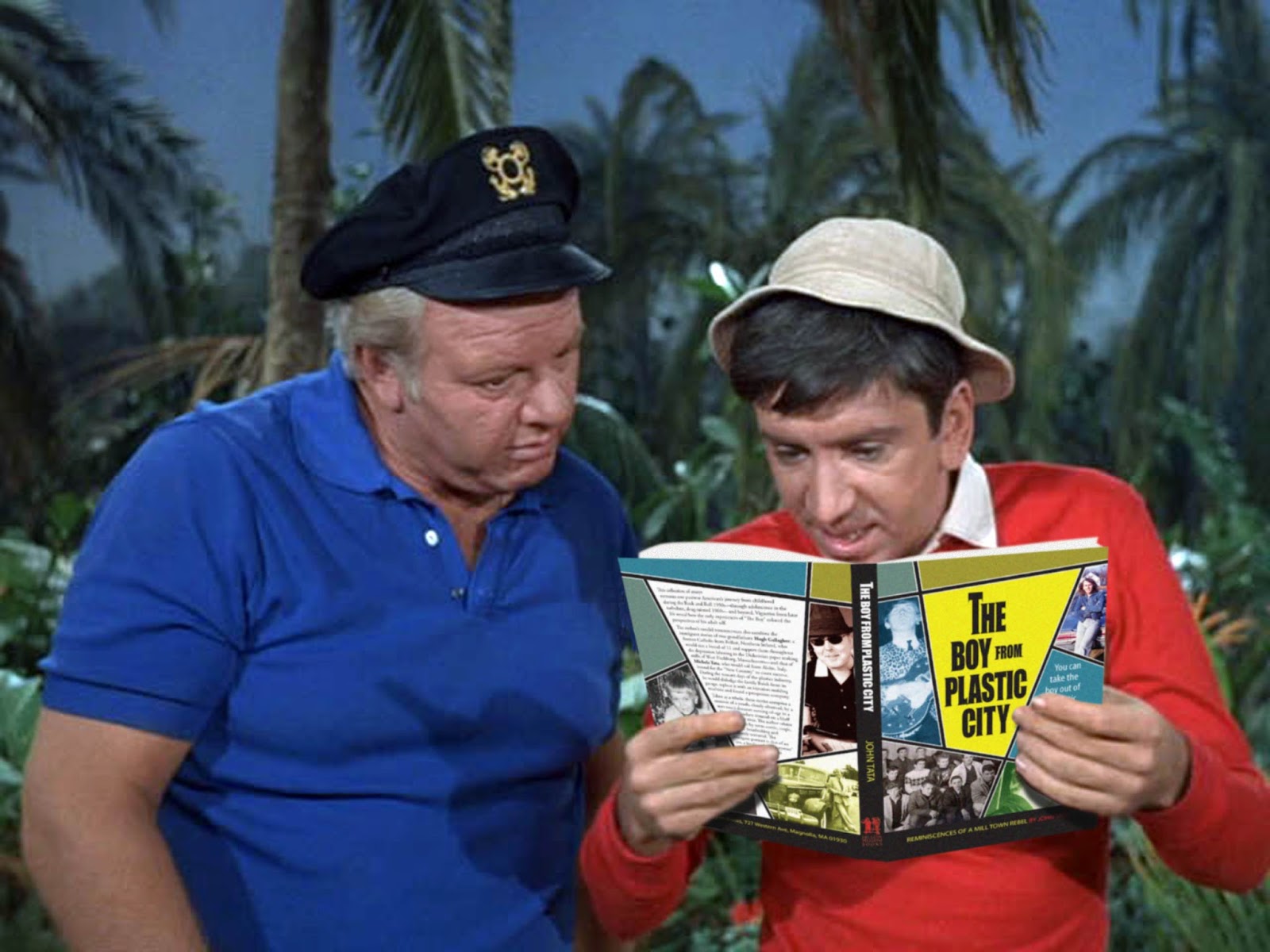 |
| Skipper, this might be the key to getting off the island. |
Subscribe to:
Posts (Atom)