Featured Post

Monday, September 30, 2019

Cholame

My plan is to publish a revised version of my memoir "The Boy from Plastic City" along with the blog of the same name. On this the anniversary of James Dean's death, I offer this essay on his career and my idolatry of the star during my early teens. Submitted for your amusement. To obtain a copy of "The Boy from Plastic City" please go to: 
http://www.amazon.com/dp/0692625437

Prelude:

On September 30, 1955, James Byron Dean’s meteoric rise to film stardom was cut short when his newly-acquired Porsche Spyder collided with a Ford outside of Paso Robles in Cholame, California. Jimmy’s intended destination had been a sports car competition at Salinas where he planned to enter the car marked with a 130 and the nickname “Little Bastard.” At first he planned to trailer it to the race but had opted for photographer Sanford Roth to shadow him north with the empty trailer in tow. He did not take the scenic route up the coast—he wanted to shake out his new toy on 466 where he could open it up a little. 

When the driver of a two-toned Ford, Donald Turnupseed, made the decision to make the left onto 41 from 466 he had misjudged the speed at which the Spyder was barreling at him. Dean had taken for granted that the Ford would give him the right-of-way until he passed before making its turn. Porsche mechanic Rolfe Wurtherich was riding shotgun that day. Wurtherich (who was thrown from the vehicle in the crash) survived and later recounted that the young actor had yelled “That guy up there’s gotta stop; he’ll see us,” as the Ford began to lumber across the white lines. It was the actor’s last spoken line on Earth. At 24 he had lived up to his credo to, “live fast, die young and leave a good-looking corpse.” It was 5:45 p.m.
•
In the summer of 1990 I was given a two-week assignment to edit a technical manual at a company facility near Santa Barbara. The job entailed physically pasting type corrections into an existing mechanical board and was a real blast-from-the-past kind of project execution-wise. The tools were: an IBM Selectric (with a type ball), an X-acto knife and a can of rubber cement. It was the worst type of Kamikaze/Nazi-Frankenstein paste-up job and represented the last time that I would use a drawing board to do my work. The time would pass however and it was a chance to see a bit of California (to which I’d never been nor been back to since). The middle weekend was approaching and I kicked around ideas for keeping myself amused with the guys in the office offering suggestions. 

Disneyland came up and although I had told my mother in no uncertain terms back in 1955 that I was definitely going there after seeing it being constructed on the Mickey Mouse Club program, I was finally getting my opportunity—and balking. It was a few decades late in coming I’m afraid. Anyway that’s a place you bring kids to. They described the Hearst Castle which sounded interesting and would put me on the Pacific Coast Highway heading north which I liked the idea of. I brought up my interest in the James Dean accident site in what I remembered as being at Paso Robles but they knew to be Cholame. Bear in mind that this was pre-Google era.
•
On Saturday morning I took off with my sketchy plan that might (or might not) involve San Francisco as a final destination. Along the way I spotted some zebras in the fields off the road and knew I was either having an acid flashback or approaching the Hearst property at San Simeon. I pulled into the vast parking lot but upon seeing that tour buses would be a necessary component of the experience, made a U-turn and pulled back onto the PCH.
I had always assumed this would be the route that James Dean would have chosen on his way to the races at Salinas but this was not the case. Still, I was happy to have a solid destination on that beautiful day. At San Luis Obispo I turned towards Route 41 and Cholame and as I got closer my mind drifted back to 1961.
•
When James Dean died in 1955, I was all of eight-years-old and had more interest in Annette Funicello's underpants than him or the circumstances of his death. His was just another face in my mother’s movie magazines. I did have one faint memory about the blond actor in a red jacket and cars driving off of a cliff, so maybe someone had taken me to see "Rebel Without a Cause," but I’m sure the plot would have been over my head.

But something clicked in 1961. Maybe I was at an age where I was feeling a teenager's alienation, anger and seeking something to identify with when I caught a TV broadcast of "Rebel" and a light went on in my head. It was like I was somehow seeing myself in the flickering pixels. I started seeking out his other movies—"Rebel’s" bookends: "East of Eden" and "Giant." Occasionally there were special showings of his work from back when he was cutting his teeth on live television but they were few, far between and therefore to be savored. I started assembling a scrapbook torn from old magazines. I was finding them in used book stores by grabbing handfuls of publications from 1955 and going through page-by-page in the event that there would be a snippet here or a picture there. My girlfriend’s older sister donated her collection to mine and so it expanded. Geno and I even went on a special mission to find archived articles at the Leominster Public Library. He ripped out a plum spread from Life Magazine, stuck it into his motorcycle jacket and we jumped out the back window. Such was the extent of the obsession.
I started to ape Jimmy’s patented slouch, scrunched my face into contorted, tortured expressions and pulled my hair out by the roots trying to make it look like his. With my conk perfected, my facial muscles trained into a Deanish rictus and my voice altered to approximate his nasal Hoosier drawl, all that was needed was a cherry on the top—that Technicolor red windbreaker—and it wasn’t hard to find.
Looking back on those days with the objectivity of time, it all must have seemed kind of…eerie. I can even remember a high school counselor expressing concern over this idolatry of a dead man to which I just shrugged my shoulders. You either got it or you didn’t. My mother was actually disappointed to see me abandon my allegiance to Elvis, whom she’d come to like, but for me at that time, the singer seemed to have lost his relevance. 

Over the years, I have come to learn that the James Dean that I had deified from his movies bore little resemblance to the star in real life. I came to see the confident, competitive, articulate actor, bursting with talent, moody, complex and wide open to life. His art was more than what he put up on the screen and stage; his greatest masterpiece would be himself, man as Art. Moreover he was far cry from the hurt/vengeful boy of "Eden", the rebel/hero trying to be accepted in the painfully dated "Rebel" Without a Cause or the lovelorn rags-to-riches punk he portrayed in "Giant." Dean is not without his detractors, but long after my obsession passed, he remains an acting genius in my estimation. If you can touch someone’s life with your art to the degree that he had mine it’s an achievement worth noting. 
•
Now in Cholame I looked for landmarks along the highway. I knew that I was near the scene of the accident and I noticed a little diner on my left so I drove down to the next intersection to turn around. I didn’t know it at the time but that’s where the crash occurred. I went into the restaurant and sat at the counter figuring I’d get a hamburger and a beer and maybe make a little small talk about the famous actor who had died nearby. There was a small amount of memorabilia on the walls to look at while I waited but after a while when no one came to wait on me I got up and left. Outside in the yard of the diner there was a scrubby looking tree that had a large abstract chrome sculpture wrapped around it dedicated to Dean. A bronze plaque nearby explained that it was a gift from his fans in Japan. There were only a few people milling around and it occurred to me that this would be an appropriate moment for a symbolic gesture. I would leave my red windbreaker (one of a long line of many—this one with a polo player on the breast) on the sculpture as an offering and leave, thus marking the end of an era. I walked over and removed my jacket, hung it on the memorial, took a picture of it then turned my back and went to my car.
•
Coda:

The physical death of James Dean marked the birth of his legend. He’d only lived to see one movie released which was East of Eden, perhaps his best. Because of his startling death at a young age, the debut of "Rebel Without a Cause" created a sensation. Today there are still remembrance rallies in Fairmount, Indiana where he was born, while in California devotees still make the (somewhat morbid) drive up 46 retracing Dean’s stops along the way as if they were the Stations-of-the-Cross: Donut at the Farmer’s Market; site of the speeding ticket; Blackwell’s Corner for apples and Coca-Cola; haunted Polonio Pass and finally the crash site itself. But his fans are growing old now and dwindling in number. He has no oldies on the radio, no major tourist attractions, or (Heaven help us) James Dean impersonators to perpetuate his memory or generate new fans. There remain only a handful of films that may or may not have stood the test of time to define his legacy. Whatever one’s judgment of them may be, I maintain that Jimmy’s power and artistry in those roles still hold up. 

It would be more poetic to say that that’s where the story of my impromptu pilgrimage ends—but it isn’t. Actually I sat in my rental for a while with the engine idling, looking over at the sculpture reflecting the California sun with my red jacket fluttering in the breeze from an appendage. It was no use. I got out of the car, retrieved the jacket and drove off in the direction Monterey.
Although I haven’t worn it since, the Technicolor red windbreaker hangs in my cellar to this day, a vestige of my youth, smelling old as do all the yellowing magazine clippings that I still keep in a cardboard box on a shelf. I can’t seem to bring myself to throw them out...yet.

Thursday, February 28, 2019

Man this guy is such a Rebel. I bet these stories might make a great movie!

Buy "The Boy from Plastic City" here.

Wednesday, June 6, 2018

The Season Of War


Yesterday was the 50th anniversary of the assassination of Robert Kennedy so I'm posting this essay from my book,"The Boy From Plastic City" in his memory. As far as the book goes it sold reasonably well given that it's self-publlshed. I'm going to put a revised expanded version shortly and tinker with blog and website. Watch this space, as they say. John.
The Season Of War
The year was 1967 and the season of war had come around again. It seems that there was a meat grinder in Southeast Asia called Viet Nam (which nobody had ever heard of) that was putting a lot of 19-year-olds into new wardrobes. Before the year was up I’d be “wearin’ the green” myself and not just on St. Patrick’s Day. This would, however, necessitate a flight to Fort Bragg, North Carolina for a fitting. 
I’d drawn a low number in the draft lottery, passed a pre-induction physical and kept finding ominous invitations from Uncle Sam in the mailbox. Even though I explained that I was planning to shampoo my hair that year, he was not allowing me to gracefully decline. Unless something came along to change things, I’d be going bye-bye and very shortly too. Some guys were running off to Canada to avoid the draft but I knew I couldn’t do that—it actually sounded worse in a way. I asked my mother if I really had to go but she just shrugged her shoulders and reminded me that her brothers had served in WWII and did not wait to be drafted with patriotism running strong after Pearl Harbor. I guess I was hoping she would get me off-the-hook somehow: maybe call in and tell them I was sick or something. But after that conversation, I knew there was no hope. I was going. 
At that time I was playing bass in a band called the Cavemen. I’d originally gotten the gig by filling in for the rhythm guitarist, Mike, while he was taking six-months active duty training as part of his requirement for the Massachusetts Army National Guard. Mike had since returned but I stayed with the group anyway when Pete—the former bassist—left. The only catch being that I needed to learn to play bass. The drummer, Paul, keyboardist Dennis and new member Lenny were all in the same Guard unit as Mike: Company B, 26th Aviation Battalion, the Yankee Division drilling in the Plastic City. They said they would keep an eye out for an opening and sure enough one eventually did come along. These Guard positions were in high demand because of the unpopularity of that war and I was lucky to get a jump on the posting.
Now it was my turn in the barrel. The deal was; you’d take basic training and advanced individual training with the regular Army, but rather than being shipped off to exotic ports-of-call, you went home and settled in to fulfill your six-year commitment—one weekend a month at your armory and two weeks at Camp Drum, New York in the summer. My fellow Cavemen threw me the obligatory going-away drunken bash to ensure that I would be ghastly ill for my bus trip to Boston and my flight to DC with connecting flight to Fayetteville, North Carolina for some hot fun in Joo-lie sun. It was on this, my first flight ever, that I encountered Robert Kennedy.
RFK
I’d seen Bobby and his brother Ted from the window of the plane as they were boarding at Logan. They had so much luggage that they were personally supervising its loading into the hold. Although Bobby would not officially announce his candidacy for president until the following March, there was a lot of buzz about him following in his brother John’s footsteps—something he would do in the most tragic way in June 1968. To put the events into perspective, I should note that JFK was revered as a near-saint in our house. His campaign, nomination and ascension to the Oval Office was a thrill ride for my mother who could relate well to his upbringing in another large Irish-Catholic family from Massachusetts (major economic differences aside). She also found him handsome. Truth-be-known, I think she loved him. 
I was home sick from school when JFK was shot. My mother and I were watching two different television stations as the news began to trickle out of Dallas. She would come to my room periodically to compare reports with me. Finality came when Walter Cronkite lifted the horn-rimmed glasses from his watery eyes, looked a clock on the wall and announced that the president had died at one p.m., Central Standard Time. It felt like a personal loss. My mother was shattered. Now Robert wore the Kennedy mantle and seemed destined to lead the country. 
Once our jet leveled-off, Bobby appeared at the door to the first-class section and struck up a conversation with the coach passengers in the front rows—doing a little campaigning I suppose. I was 10 or so rows back and could not make out what was being said. I only heard sporadic bursts of laughter. RFK made the cabin electric. Standing during the entire flight in the doorway he never stopped smiling with those big Kennedy choppers as he chatted up the passengers. He appears now in my memory in vivid Technicolor; white button-down shirt with repp tie, blue eyes, tanned by the sun, threads of grey mixing in with the famous mop of auburn hair. Bobby had sometimes come across as arrogant and tough in the media but it was nowhere in evidence that morning. He didn’t return to his seat until it was announced that they were beginning the final approach to Dulles. With a small wave and a smile he was gone.
After landing in DC, Mooney—another Massachusetts guardsman heading down for basic—went off to get some travel information for the next leg of our journey to Fort Bragg while I stayed watching our bags. I was standing next to what seemed to be a mountain of brown leather suitcases that turned of to belong to the Kennedy entourage. I knew because left guarding that stack was none other than the astronaut and Kennedy running-buddy, John Glenn—first American to orbit the earth. Glenn was a huge celebrity and national hero in those years and it seemed a little demeaning in my eyes to make someone of that stature stand there like a goon watching the luggage (well, like I was). He noticed me looking in his direction and I would swear he seemed a little embarrassed. 
Coda:
There is a famous photograph of Robert Kennedy’s bleeding head being cradled by a busboy the kitchen of the Ambassador Hotel as his life seeped out of him. It always makes me think of Abraham Lincoln. In my memory of that July day of the flight to Washington, I see him as he looked on the plane, bathed in brilliant sunlight. It was like seeing Lincoln alive again, standing, smiling and chatting in the doorway to first-class, all in vivid Technicolor.

Tuesday, April 4, 2017

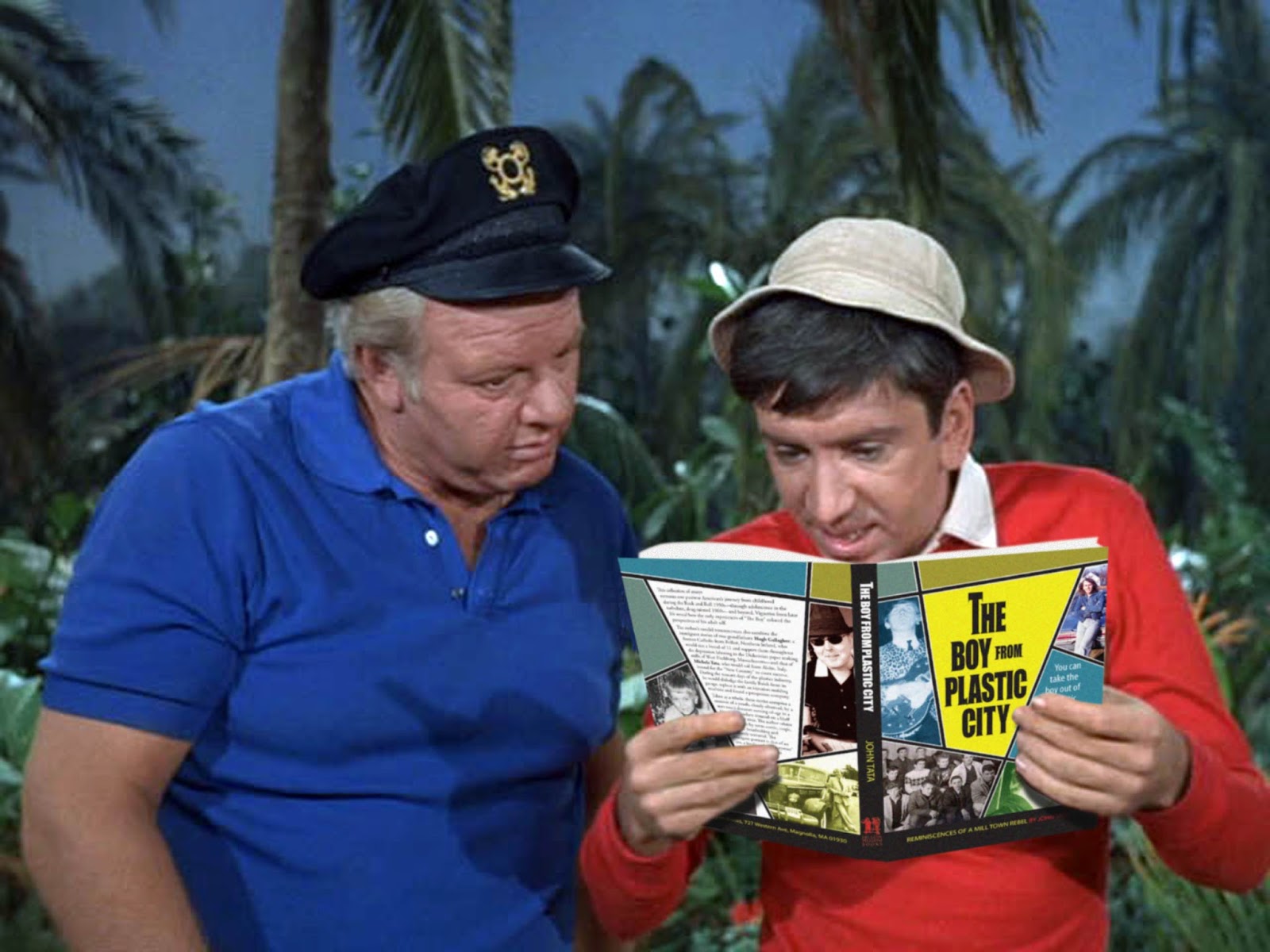
Gilligan

Skipper, this might be the key to getting off the island.
http://www.amazon.com/dp/0692625437

Friday, March 17, 2017

Taylor Swift

http://www.amazon.com/dp/0692625437
Maybe I'll buy a summer home in the Plastic City.

Friday, August 19, 2016

Brother Bones


Prelude
It was the premiere of their yearly minstrel show and the young men of St. John’s parish school were on parade. In keeping with the tradition’s format—one that had not changed appreciably in a century—they danced and pranced their way from the school to the auditorium, shuckin’ and jivin,’ rattling tambourines, whacking at banjos, smeared with greasepaint and singing “When The Saints Go Marching In” to the high heavens. A small marching band provided the music albeit somewhat off-key. An oompah tuba blamed the bottom end and the big bass drum held down the rhythm. This pre-show was for the amusement of the assembled ticket holders—among them Aunt Mag and John McGowan—queued up in the cold, waiting for the signal to enter. It was a peek at the spectacle that they would soon see in full, like when they lead the elephants over to the circus tent. These Irish-Catholic boys were dressed in gaudy costumes down to their handmade top hats. Their make-up was not amber, beige, buff, burnt umber, chestnut, chocolate, cocoa, russet, tan or taupe. It was black, and the garish white greasepaint that outlined their mouths was something out of a nightmare. The fact was, most of them had never seen person-of-color unless you wanted to count Stepin Fetchit or Buckwheat from the movies. They did know Amos ’N’ Andy from radio, but not the fact that they were always voiced my Caucasians. So this was what they supposed the “darkies” looked and acted like. These stereotypes had been passed down from the mid-1840s through the folk-art form of Minstrelsy, born in the year the bricks for the Beoli Mills were being mortared into place.

Rituals
Along with placing poinsettias at my mother’s final resting place after each Christmas, I stop at the family plot of her parents, aunt, uncle and brother. It’s always the end of December and it’s usually bleak and cold—sometimes bitterly so—and blustery enough that it’s a trick to keep a votive candle burning even for a minute. For the sake of survival, I find that a nip of Jameson’s is advisable, and, I like to think, apropos. The monument that marks this family plot is substantial yet without artifice which might also describe those at rest beneath. It’s a double-sized slab of grey granite with a serpentine top. Notches at the top corners are the sole adornments. The epitaph gets efficiently down to business as well inscribed as follows:
1886 JOHN J. McGOWAN
HIS WIFE
1874 MARGARET M. CRONIN
1891 HUGH M. GALLAGHER 1958
HIS WIFE
1891 HANNA M. CRONIN 1975
SON
1915 JOHN V. GALLAGHER 1937
Hugh and Hanna were my grandparents, and their son, John was my namesake. But it’s John McGowan and Aunt Mag that I’m considering today—one specific incident in particular. I observe that their years of death are not etched into the stone, which leads me to believe they were still alive in 1958—the year I’m guessing that this stone was placed with the passing of my grandfather. I’ve spoken of Aunt Mag in previous installments. She and her husband were Irish immigrants from the area of Knockmanagh near Killarney in the Southwest corner of the “Auld Sod.” They were the ones who sponsored my Grandma, Hanna, then a doe-eyed 18-year-old colleen—in the new country. Doing the math that would have been around 1910. Due to the repressive policies of their English colonial overlords, Irish children were kept under-educated (therefore less dangerous I suppose) which made the task of relocating to America and finding a decent job all the more daunting. As with many Irish immigrants, Hanna found work as a domestic in service to Fitchburg’s British Brahmin expatriates.

Once Hanna met and married Hubert Gallagher, they moved into a 10-room farmhouse on Baltic Lane in West Fitchburg provided by his new employer Crocker Burbank: makers of paper. He could easily walk to his job which was in Number Eight mill right next door. They had an extended credit line to buy their necessities from Crocker’s own co-op market up on Ashburnham Street and for all intents and purposes, you owed your soul to the company store, just like in that old saw, “16 Tons.” In fairness, there were to be plenty of those pesky necessities attending the births of the 11 children that followed, and—soul possession aside—there’s something to be said for a steady income. Especially with the Great Depression taking shape on the distant horizon like some worrisome, unknowable beast being born ugly.

~

Beoli Mills
John McGowan and Aunt Mag lived a mile or so away from the Gallaghers in a compact Mansard-roofed, two-story dwelling at 34 Sprague Street where it wound down at a precarious pitch towards the North Nashua River. As with my grandfather, Mr. McGowan could easily walk to his place of employment at Beoli Mills on Westminster Street, clicking the heels of  his spit-shined brogans in the face of the rising sun as he went. That leg of the commute was a breeze; a hundred cement stairs from his back yard; down onto Sanborn and then left on Simonds. Slogging home after his shift might call for some liquid fortification at the British-American Club or the Log Cabin before scaling that slope and facing his frequently feisty better half and her imposing arsenal of Blue Willow china.

Beoli was a textile mill operated by the American Woolen Company and John worked there as a “Finisher.” Architecturally the building could have been part of a Nazi concentration complex with it’s anxiety-inducing brick facade. The assortment of buildings were as varied in form as a capricious child’s grab bag of geometric shapes. At one corner stood a battlement-like tower capped with a giant onion dome which wouldn’t have looked out of place in Moscow. Old photos show an abundance of windows however so some cheer must have filtered down onto those otherwise drab, lanolin-soaked floors. The company provided John with solid employment for 25 years until it went belly-up—yet another Depression casualty in an era of many. The equipment was sold and the jobs were lost. But John McGowan was close enough to retirement age that the two events dovetailed as well as could be expected and he and his Maggie would be okay if they played their cards right—they hoped.

~

Cakewalk
Once inside the marching musicians joined the piano and drummer in the pit and the show’s Overture began. Snippets of popular songs and chestnuts from the Stephen Foster catalogue wafted through the room. As always, the minstrel show would be divided in three. In the first, the entire troupe would take to the stage warbling “Ain’t She Sweet” as they did a cocky cakewalk on from stages left and right to a thunderous ovation. It was hard for the audience to believe that these were their own sons, relatives and sons of friends as they tried to recognize them under their makeup. Freed of any stage fright by the anonymity afforded by disguise, these often-times shy youth appeared loose-as-geese in the footlights and hammed it up shamelessly. The Interlocutor appeared and instructed his minstrels to take seats in semi-circles to either side of his elevated perch. Also attired in a minstrel-fashioned costume (except for the blackface), the Interlocutor served as Master-Of-Ceremonies as well as somewhat pompous straight man for these mad proceedings. He was flanked by the so-called end men—Brother Tambo and Brother Bones. These two characters (caricatures?) got to set up the gags and deliver the punchlines as the rest of the cast rollicked in exaggerated mirth and jangled their tambourines. The concept of Surrealism was known in the thirties though what they might have called it back at its creation in the 1840s is a mystery, yet the term seems to describe the Minstrel Show experience best. A sampling of the humor is as follows:
Interlocutor: No, Bones, you mean three days previous to her decease. 
Brother Bones: No, she had no niece.
Interlocutor: I presume he was a pretty good physician? 
Brother Bones: No, he wasn't fishin'; he was home.
Interlocutor: I mean he was a doctor of some standing. 
Brother Bones: No, he wasn't standing, he was sitting on a three-legged stool.

At the conclusion of the Part One, the assembled cast along with the Interlocutor cakewalked back off the stage carrying their milking stools to another round of applause. The boys were far from stage frightened, the fact was they hated to leave the spotlight. Given the conditions of the times, this explosion of farce, color and music was a welcome respite from their grey existences and they were elated.

~

The Auction
In 1932 the physical plant of Beoli Mills—minus the textile producing equipment—went on the auction block. The proceedings would take place in the huge empty plant. Addison Freeman of Boston’s Samuel T. Freeman and Company would serve as auctioneer. His firm had previously announced that the property would be offered in its entirety first and then in four separate parcels. Whichever brought the highest bid would prevail.

Mr. McGowan’s motivation for wanting to purchase his former place of employment is at least partially conjectural and remains part of the lore of this grey Irish enclave of blue-collar labor nestled in amongst the granite hills. The legend would have us believe that a stop at the British-American club with a group of his peers before proceeding to the auction had perhaps impaired his judgment. But even into his cups, he made a cogent case to his former co-workers that it was a sound investment without revealing what he was about to lay on the table lest someone else beat him to it. He was confident that the economic pendulum would swing the other way eventually—wouldn’t it? Then again, what was the satisfaction of owning the place that you once slaved in. Regardless of his motivation he came prepared to buy. What was up for grabs was substantial too: ten mill buildings with 175,150 square feet of floor space and a large power plant located on several acres of land. The assessed value of the complex was $128,000 but during the peak years of the textile industry it was employing 600 souls (1926-1927), and was worth $264,100. After laying out the rules of the auction, Addison Freeman started the bidding with a “clarion” call that echoed off of the brick walls of the cavernous space, “How much am I offered for this property in its entirety?”

The scores of former employees that he’d just been drinking with bated their suspicious breaths and waited for the bid. Then came McGowan’s booming baritone, “ten thousand dollars.” It was the only offer so it was “knocked-down” to him. His former coworkers gaped at him in slack-jawed astonishment, and you could have heard a pin drop. When the newspaper reporter asked him what his intentions were for the property, he replied, “I am ready to sell it to anyone who is ready to pay me my price.” He also declared himself to be acting as sole agent. It was his and he planned to flip it. 

But on the dark way home, with the echoes fading in John’s ears with each footfall, the scaling of Sprague seemed to be taking a preternaturally long time. Now was the figurative cold, grey, light of dawn and as he approached the buttery luminescence of his own parlour windows, he began formulating the rationale with which he would present his case to Maggie—all 90 pounds of simmering Irish TNT. 

Put gently, she was not pleased. True; they had managed to scrape together $10,000 or so but not much more, and they were getting up there in years. What John hadn’t brought into the equation, Mag reminded him, were things like taxes on the appraised value ($128,000) and such mundane matters as building maintenance. It was clearly time for some damage control. They secured a lawyer and were able to extract themselves from the deal but at a cost of a couple of thousand dollars from their nest egg—money they were counting on. That class-consciousness that their neighbors brought over from the old country was still pervasive and there was a certain amount of self-satisfied blather behind the McGowans’ backs about them and the knives came out, as they will. Who did they think they were, anyway?

~

The "Olio"
The second act was called the "Stump Speech", a lone dissertation the main purpose of which was to allow the backstage to be set for the elaborate "Afterpiece." On this cold night, the custodian, Mr. James O’Brien, had stoked the coal furnace higher than normal for the comfort of the audience at the show, and between that and the rising body temperatures, the low-ceilinged auditorium became as hot as a Lakota sweat lodge, and the audience began peeling off any unnecessary clothing. 

Brother Bones took to the stage and began to pontificate on everything from science, society and politics during which his dim-witted character attempted to speak eloquently, only to deliver countless malapropisms, jokes, and unintentional puns. As he did, he moved about like a clown, standing on his head and often prat-falling off his stump. He delivered salient social criticism with the focus being on sending up unpopular issues and making fun of blacks’ supposed inability to make sense of them. Since local gossip was a fair target, Brother Bones introduced a song that he’d written especially for the occasion entitled: “The Day John McGowan Bought The Beoli Mills.” Although no record of this ditty exists, the imagination can provide a sketch.

With his black greasepaint running grotesquely down his face, Brother Bones delivered his mocking ballad directly towards John and Mag dead center in the audience like a command performance.
Within a peal of laughter, the furious McGowans donned their overcoats and stormed out. They would not be staying for the Afterpiece after all.
~
Coda:
I actually saw a performance of St. John’s Minstrel Show many years later, long before the term “politically correct" had been coined. 

Codetta: 
Aunt Mag and John McGowan lived to ripe old ages. They were not rich but they were okay—as he had hoped. Had they stuck with purchase of the Beoli Mills and then sold during the Depression’s end in 1940, they may have  enjoyed a truly golden age. But then again…?